Voicemail Is Not Dead: It's Just Read, Not Heard
By Collin Russell · Published · 4 min read
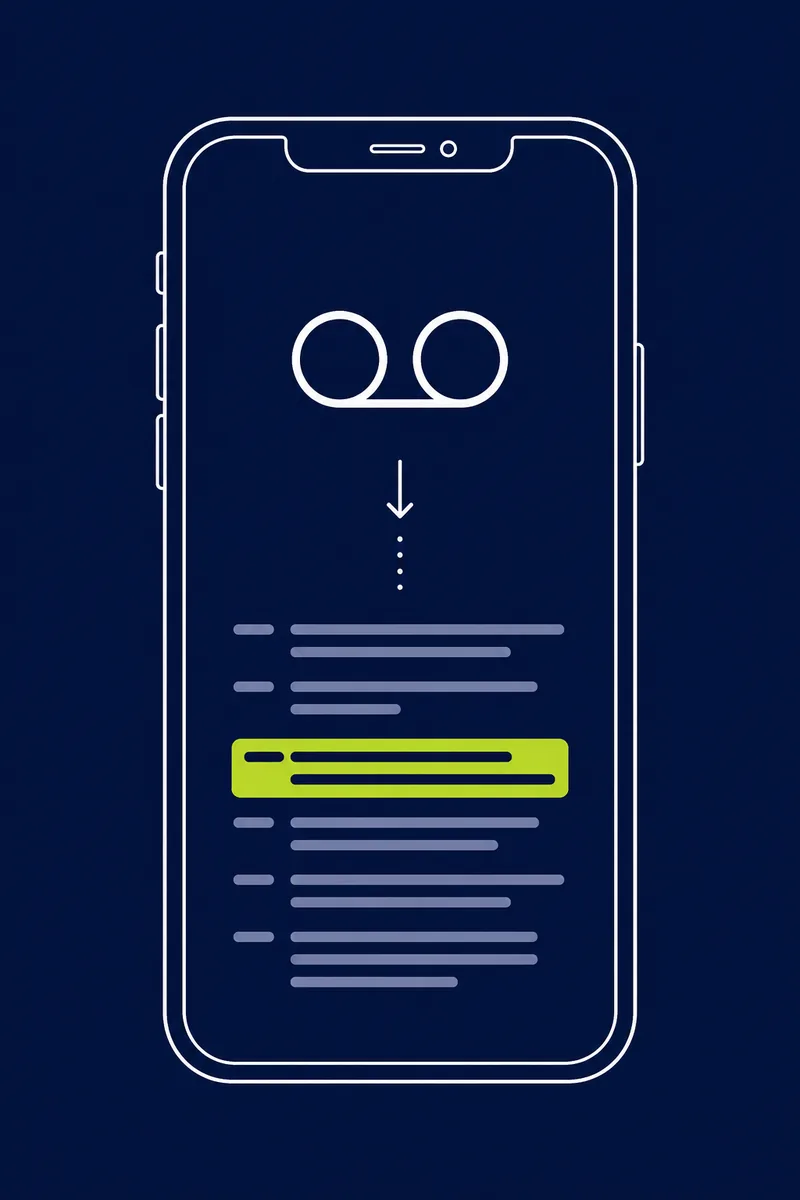
For years, "voicemail is dead" has been conventional wisdom in sales. The data mostly backs a different story: voicemail isn't dead, it just changed medium, and the shift to text has gone further than most sales advice accounts for.
Transcription is now close to universal
Over 91% of active iPhones run iOS 17 or later, which shifted voicemail to on-device live transcription displayed on the lock screen as the caller is still talking. Cloud business phone platforms - RingCentral, CloudTalk, Nextiva, and similar - transcribe by default and push the text to email, mobile apps, and CRM records alongside the audio. The practical result: most people are looking at text before, or instead of, listening to audio. Reading a transcript takes 10 to 15 seconds; dialing in and listening to the audio takes 47 to 60 seconds. Given that gap, the audio option is losing by default in most inboxes.
Reading it isn't the same as responding to it
That's the part worth being precise about, because "people read voicemails now" quietly implies "people engage with voicemails now," and the data doesn't support that leap. The dominant outcome of a cold voicemail, transcribed or not, is rejection:
- 62% of business voicemails go unreturned
- 82% of voicemails from unknown numbers are ignored outright
- 80% of callers who reach voicemail don't even leave a message
Transcription changed how people triage voicemail - instantly, by scanning for urgency and a recognizable name - not whether they engage with it. The realistic bar for a cold voicemail was never "gets answered." It's "survives the ten-second scan instead of getting deleted immediately."
Where transcription accuracy quietly matters
One bad transcription of a name or a number is enough to turn a specific, credible message into noise.
Speech recognition on real cellular audio runs 80-90% accurate - well below the 90-95% you get in ideal, quiet conditions - and drops further on technical jargon or an unfamiliar name. Specialized numeric models get callback numbers right up to 99% of the time even when general transcription accuracy is lower, which is one reason a clearly-stated number still matters even in a mostly-text world.
A voicemail written to be heard leans on tone and pacing to survive a mangled word here and there - a listener's ear fills in gaps a transcript can't. A voicemail that's going to be read as a possibly-garbled transcript needs to work even when a word or two comes through wrong: front-loaded with the reason for the call, short enough to survive a glance, specific enough that one bad transcription doesn't sink the whole message.
Who's actually reading the transcript, and when
Engagement also isn't evenly distributed across the day or the role. Cognism's data puts peak callback and reply windows at 10-11:30am and 4-5:30pm, with Tuesday and Thursday outperforming the weekly average - the same pattern that shows up in voicemail response generally. Technical roles in particular default almost entirely to asynchronous text triage: one tracked cohort of software engineers showed voice interruptions correlating with measurably worse focused-work output, which is a fair proxy for why that audience screens especially hard. And in regulated industries like healthcare and finance, automated transcription is often disabled entirely by default to avoid transmitting sensitive information over unencrypted channels - a caveat worth knowing if a target account happens to sit in one of those verticals.
Even a hang-up beats no signal at all
It's worth remembering the alternative outcome, too: 80% of callers who reach a voicemail box don't leave a message at all. Whatever the odds against a callback, a specific, transcribable voicemail still leaves a trace a silent hang-up never does - a name, a company, and a reason sitting in a prospect's inbox, ready to be searched or half-noticed later, instead of nothing.
The takeaway
"Hey, it's Alex from [Company], give me a call back" reads as spam whether it's heard or misheard - the medium doesn't rescue a generic message. A voicemail that references something real and specific about the prospect's company survives the ten-second scan, transcription errors and all, which is exactly what artificial intelligence-assisted research makes possible at scale: a message specific enough to read as legitimate even filtered through an imperfect algorithm's best guess at what was said.